
I study how social ties, technology, and institutional trust shape people’s evaluation of information and misinformation. My research explores the communication processes that drive public opinion, attitudes, and behavior, particularly in contexts where trust is contested and information is politicized.
These questions are increasingly important against the backdrop of rapid technological change and deepening sociopolitical divisions. Emerging technologies, including generative AI and algorithmic personalization, are reshaping how people encounter and interpret information. Combined with declining trust in traditional institutions, this shift threatens our collective ability to make informed decisions and address pressing challenges.
My work draws on several methodological frameworks, including computational social science, network science, and survey research. Most of it is done in R; you can find my R tutorials here and code on GitHub. My recent papers are listed on the publications page.
Current projects
The Civic Health and Institutions Project (CHIP50)
This multi-university initiative built an infrastructure for large-scale survey data collection with unmatched temporal and spatial granularity across all 50 US states. During the COVID-19 pandemic, it provided insights into health behaviors and policy attitudes. The project has since expanded into a broad civic survey capturing critical trends in health, politics, inequality, trust, and public behavior.
By 2025, CHIP50 had collected 35 waves of survey data, with a typical sample of roughly 25,000 participants per wave and over 900,000 total responses. Surveys are augmented with social media and digital behavior data. In 2025, the project received the Warren J. Mitofsky Innovators Award from the American Association for Public Opinion Research (AAPOR), recognizing its novel social science data infrastructure. CHIP50 provides a rich empirical basis for testing models of information diffusion, media effects, and social influence. As of 2025, it has been cited in over 200 NIH-indexed papers and more than 500 scholarly works overall.
The National AI Opinion Monitor (NAIOM)
This project systematically tracks public perceptions, knowledge, and trust in artificial intelligence technologies. As AI tools increasingly shape education, healthcare, employment, and governance, understanding public attitudes is critical for equitable and ethical AI policy. The project relies on a large longitudinal national survey with oversamples of minority populations, youth, and older adults, along with New Jersey surveys focused on key policy sectors and marginalized communities.
Early findings reveal an emerging “AI divide”: younger, wealthier, and more highly educated Americans are significantly more likely to know and trust AI technologies, while older, less affluent, and minority groups report greater skepticism and lower usage.
State of the Prompt
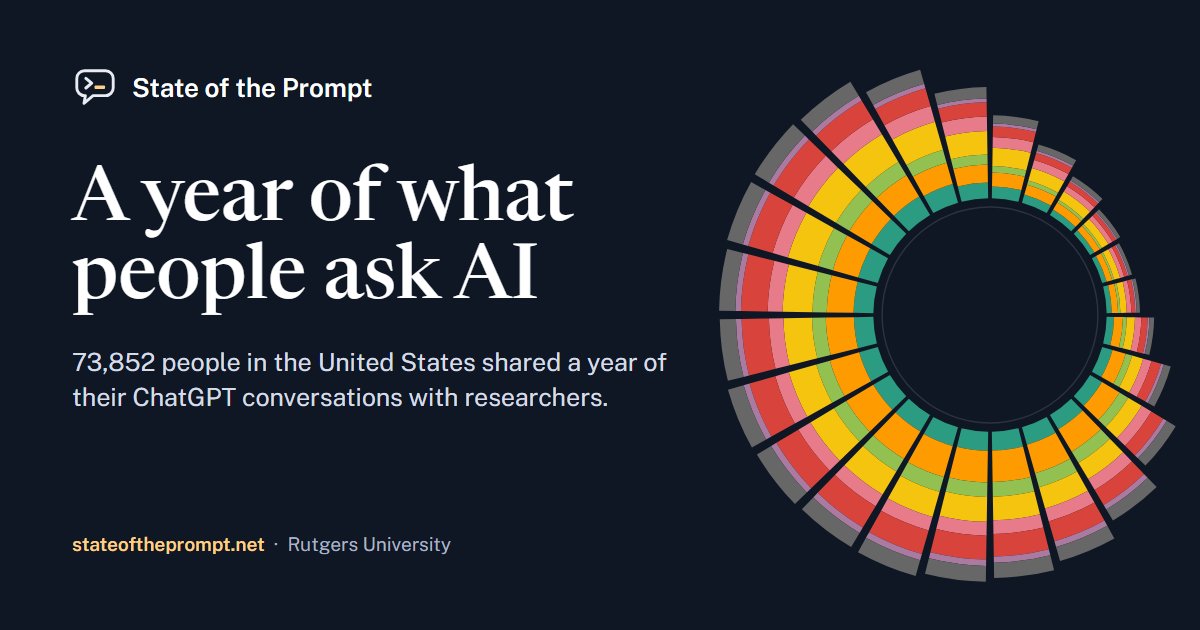
What do people actually ask AI in everyday life? State of the Prompt analyzes a year of ChatGPT conversations (July 2025 to June 2026) shared by an opt-in panel of U.S. participants: 3.4 million conversations from about 66,000 adults. A language model assigns each conversation’s main subject, and the project reports what people asked, who asked, and when, covering topics such as health, politics, and the school calendar. Results are published only as aggregates; no individual conversation is shown or quoted. The project is a partnership of the Rutgers Computational Social Science Lab and the National AI Opinion Monitor.
Rutgers Computational Social Science Lab

I direct the Computational Social Science Lab at the Rutgers School of Communication and Information. The lab is a hub where faculty and students study human behavior with computational methods, including network analysis, natural language processing, machine learning, algorithm audits, and large-scale survey research.
Earlier work
The COVID States Project
This multi-university, NSF-funded project combined monthly surveys in all 50 states with social media data from a panel of consenting respondents. Network-based survey questions allowed us to assess the spread of COVID-19 and its impact on participants, their personal networks, and local communities. The study tracked the prevalence of the virus and its social, technological, and economic consequences, examined how well Americans’ information needs were met during the crisis, and paid particular attention to communities of color, which were disproportionately affected. Reports, data, and interactive charts are available at covidstates.org.